SLVK262 February 2026 TPS7H5030-SEP
- 1
- 2
- Trademarks
- 1 Introduction
- 2 Single-Event Effects (SEE)
- 3 Device and Test Board Information
- 4 Irradiation Facility and Setup
- 5 LETEFF and Range Calculation
- 6 Test Setup and Procedures
- 7 Destructive Single-Event Effects (DSEE)
- 8 Single-Event Transients (SET)
- 9 Event Rate Calculations
- 10Summary
- A References
6 Test Setup and Procedures
There were two input supplies used to power the TPS7H5030-SEP which provided VIN and EN. The VIN for the device was provided via Ch. 3 of an N6705C power module and ranged from 12V to 14V for SEL, SEB/SEGR, and SET testing. The EN of the device was driven by an E36311A power supply and was either forced to 0V or 5V to enable or disable the device. A NI PXIe-6363 DAQ was used to drive VSNS and VCOMP.
The primary signal monitored during testing was GATE (OUTH and OUTL tied together on the EVM) and this was done so using a PXIe-5110 triggering using a pulse-width trigger at 20%.
All equipment was controlled and monitored using a custom-developed LabVIEW? program (PXI-RadTest) running on a HP-Z4 desktop computer. The computer communicates with the PXI chassis via an MXI controller and NI PXIe-8381 remote control module.
Table 6-1 shows the connections, limits, and compliance values used during the testing. Figure 6-1 shows a block diagram of the setup used for SEE testing of the TPS7H5030-SEP.
| PIN NAME | EQUIPMENT USED | CAPABILITY | COMPLIANCE | RANGE OF VALUES USED |
|---|---|---|---|---|
| VIN | N6705C (CH # 3) | 20.4V, 50A | 5A | 12V, 14V |
EN | E36311A (CH # 1) | 5V,5A | 0.1A | 0V, 5V |
VSNS | PXIe-6363 | ±10V, ±5mA | N/A | 0.6V |
VCOMP | PXIe-6363 | ±10V, ±5mA | N/A | 0.8V |
VLDO | PXIe-6363 | ±10V, ±5mA | N/A | 5V |
GATE | PXIe-5110 | 100 MS/s | — | 100 MS/s |
All boards used for SEE testing were fully checked for functionality. Dry runs were also performed to verify that the test system was stable under all bias and load conditions prior to being taken to the test facilities. During the heavy-ion testing, the LabVIEW control program powered up the TPS7H5030-SEP device and set the external sourcing and monitoring functions of the external equipment. After functionality and stability was confirmed, the beam shutter was opened to expose the device to the heavy-ion beam. The shutter remained open until the target fluence was achieved (determined by external detectors and counters). During irradiation, the NI scope cards continuously monitored the signals. When the output exceeded the pre-defined pulse-width trigger, a data capture was initiated. No sudden increases in current were observed (outside of normal fluctuations) on any of the test runs and indicated that no SEL or SEB/SEGR events occurred during any of the tests.
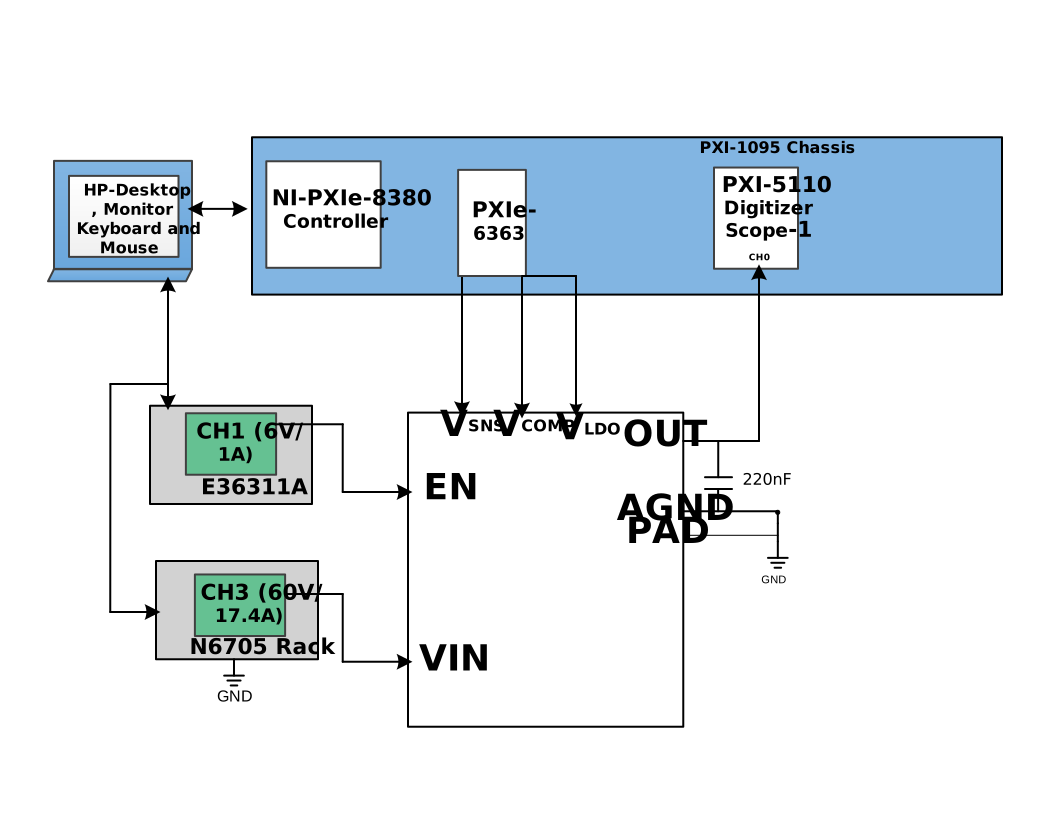 Figure 6-1 Block Diagram of the SEE Test Setup for the TPS7H5030-SEP