SLVK262 February 2026 TPS7H5030-SEP
- 1
- 2
- Trademarks
- 1 Introduction
- 2 Single-Event Effects (SEE)
- 3 Device and Test Board Information
- 4 Irradiation Facility and Setup
- 5 LETEFF and Range Calculation
- 6 Test Setup and Procedures
- 7 Destructive Single-Event Effects (DSEE)
- 8 Single-Event Transients (SET)
- 9 Event Rate Calculations
- 10Summary
- A References
7.1 Single-Event Latch-up (SEL) Results
During the SEL testing the device was heated to 125°C by using PID controlled heat gun (MISTRAL 6 System (120V, 2400W)). The temperature of the die was constantly monitored during testing at TAMU through an IR camera integrated into the control loop to create closed-loop temperature control. The die temperature was verified using a standalone FLIR thermal camera prior to exposure to heavy ions at KSEE.
The species used for the SEL testing was 109Ag at 15MeV/nucleon and 109Ag at 19.5 MeV/nucleon. For both ions an angle of incidence of 0° was used to achieve a LETEFF of ≈ 48 MeV·cm2/mg. The kinetic energy in the vacuum for 109Ag (TAMU) is 1.635GeV and 109Ag (KSEE) is 2.125GeV. Flux of approximately ≈ 105 ions/cm2/s and a fluence of ≈107 ions/cm2 per run was used. Run duration to achieve this fluence was ≈2 minutes. 6 devices were powered up and exposed to the heavy-ions using the maximum recommended input voltage of 14V and a VLDO voltage of 5V. No SEL events were observed during all six runs, indicating that the TPS7H5030-SEP is SEL-free up to 48 MeV·cm2/mg.Table 8-4 shows the SEL test conditions and results. Figure 7-1 shows a plot of the current versus time for run #1.
| Run # | Unit # |
Facility |
Device Type |
Ion | LETEFF (MeV·cm2/mg) | Flux (ions/cm2/s) | Fluence (ions/cm2) |
VIN/PVIN (V) |
VLDO |
SEL (# Events) |
|---|---|---|---|---|---|---|---|---|---|---|
| 1 | 1 |
KSEE |
TPS7H5030-SEP |
109Ag |
49.1 |
1.10 x 10⁵ |
1 x 10⁷ |
14 |
5 |
0 |
| 2 | 2 |
KSEE |
TPS7H5030-SEP |
109Ag |
49.1 |
1.06 x 10⁵ |
1 x 10⁷ |
14 |
5 |
0 |
| 3 | 3 |
KSEE |
TPS7H5030-SEP |
109Ag |
49.1 |
8.77 x 10⁴ |
1 x 10⁷ |
14 |
5 |
0 |
|
4 |
4 |
KSEE |
TPS7H5030-SEP |
109Ag |
49.1 |
8.19 x 10⁴ |
1 x 10⁷ |
14 |
5 |
0 |
|
5 |
5 |
TAMU |
TPS7H5030-SEP |
109Ag | 47.7 | 1.34 x 10⁵ | 1 x 10⁷ | 14 | 5 | 0 |
|
6 |
6 |
TAMU |
TPS7H5030-SEP |
109Ag |
47.7 |
1.27 x 10⁵ | 1 x 10⁷ | 14 | 5 | 0 |
Using the MFTF method described in Single-Event Effects (SEE) Confidence Interval Calculations application report and combining (or summing) the fluences of the six runs at 125°C (6 × 10⁷), the upper-bound cross-section (using a 95% confidence level) is calculated as:
σSEL ≤ 6.15 x 10⁻⁸ cm2/device for LETEFF = 48 MeV·cm2/mg and T = 125°C.
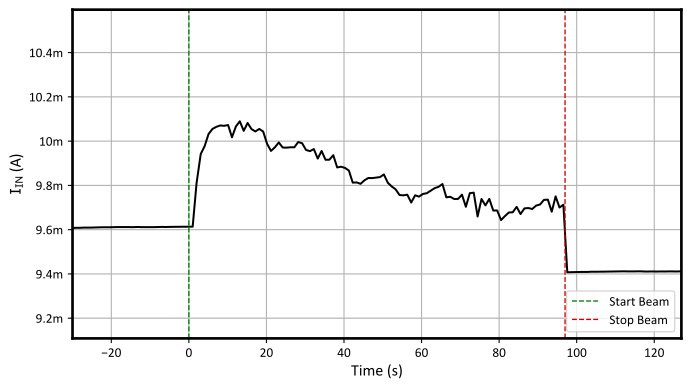 Figure 7-1 Current versus Time for Run #
1 of the TPS7H5030-SEP at T = 125°C
Figure 7-1 Current versus Time for Run #
1 of the TPS7H5030-SEP at T = 125°C